

The vocabulary: AEO, GEO, and “AI search visibility”
Three terms, one underlying discipline. They get used loosely and overlap, but knowing the differences helps you read the market:
- AI search visibility — the friendliest term. Whether your business shows up when someone asks an AI assistant for what you do. Most clients and prospects use this when describing the outcome they want.
- AEO (Answer Engine Optimization) — the practice of being the named recommendation in the answer. Optimises for “be the answer” rather than “rank on page 1”.
- GEO (Generative Engine Optimization) — the broader category. Anything that affects whether your business appears in AI-generated content — AEO plus training-corpus inclusion, citation graph, structured-data reach. In practice the marketing uses these interchangeably; the underlying work is the same.
The market searches for AEO agency, GEO, generative engine optimization more than AI search visibility. If your agency page talks about AEO & GEO alongside AI visibility, you match the for the search terms prospects actually type.
Four surfaces that matter in 2026
- Google AI Overviews — the AI-generated answer boxes that appear above Google's organic results on more and more queries. If you're in the citation list at the bottom of an AI Overview, you're showing up.
- ChatGPT — when someone asks “best plumber near Bristol” and ChatGPT generates an answer, does your business appear in the recommendation list?
- Perplexity — search engine with built-in AI. Citations are public, so your AI visibility is directly measurable. The most-cited answer engine for trade queries in 2025-26.
- Gemini — Google's own AI assistant. If you rank in Gemini, you're showing up in the future of Google Search itself.
Why does this matter for local businesses specifically?
Because a meaningful slice of queries that used to be Google-only are now going through AI assistants. Some of those queries are local — “who does emergency plumbing in Bristol”, “best dentist for nervous patients Manchester”. The businesses that get recommended by these AIs get the click, and increasingly the click is the only signal that matters.
The concrete work — what actually moves you up
Same fundamentals as regular SEO, plus a few signal types LLMs prefer. In priority order:
- Schema.org structured data. AI assistants parse structured data more aggressively than Google's main crawler. At minimum:
FAQPageon every service page,HowToon any tutorial,Organization+Personon the about + contact pages,Serviceper service. All valid against schema.org and emitted as JSON-LD. /llms.txtat your root. The AI-crawler equivalent ofrobots.txt— a curated Markdown file listing your services, locations, and authoritative pages. No AI tool is legally obligated to obey it (yet) but they read it as a recommendation signal. Missing it is the single most common “AI doesn't know about me” mistake in 2025-26.- AI-crawler directives in
robots.txt. GPTBot, ClaudeBot, PerplexityBot, Google-Extended, Applebot-Extended, anthropic-ai, CCBot — each is an opt-in / opt-out decision. Explicit rules beat implicit defaults. Either allow all (let them train / cite) or block selectively — your call, but the decision needs to be made and documented. - E-E-A-T signals. Experience, Expertise, Authority, Trust. The signals LLMs use to decide whether you're a credible source worth citing. Real author byline, contact page, credentials, last-reviewed dates, factual claims with sources cited inline.
- Content structure. Clear Q&A-shaped content, factual claims with sources cited, dated statements (“as of October 2026” rather than “recently”). LLMs prefer sources that directly address the query.
- Third-party mentions. If the Bristol Post or a local blog has written about your business, you'll show up in AI answers more reliably than you'll rank for the same terms in Google. The biggest lever.
- High review volume + average rating. AIs use reputation as a quality signal. Steady stream of genuine positive reviews is what makes them recommend you.
How do you measure it?
For Google AI Overviews: query DataForSEO for your target keywords and check whether an AI Overview exists, what it says, and which domains it cites. For ChatGPT / Perplexity / Gemini: query them with your top 20 queries and check whether your business appears in the answer. Both are automatable. The dashboard I built does it daily and surfaces a monthly snapshot in the client portal.
What I actually track — the 8 metrics on the dashboard
The admin dashboard I run on the back of the agency pings a daily prompt set against Google AI Overviews, ChatGPT, Perplexity, and Gemini for every Growth-tier client. Eight numbers matter, in roughly this order:
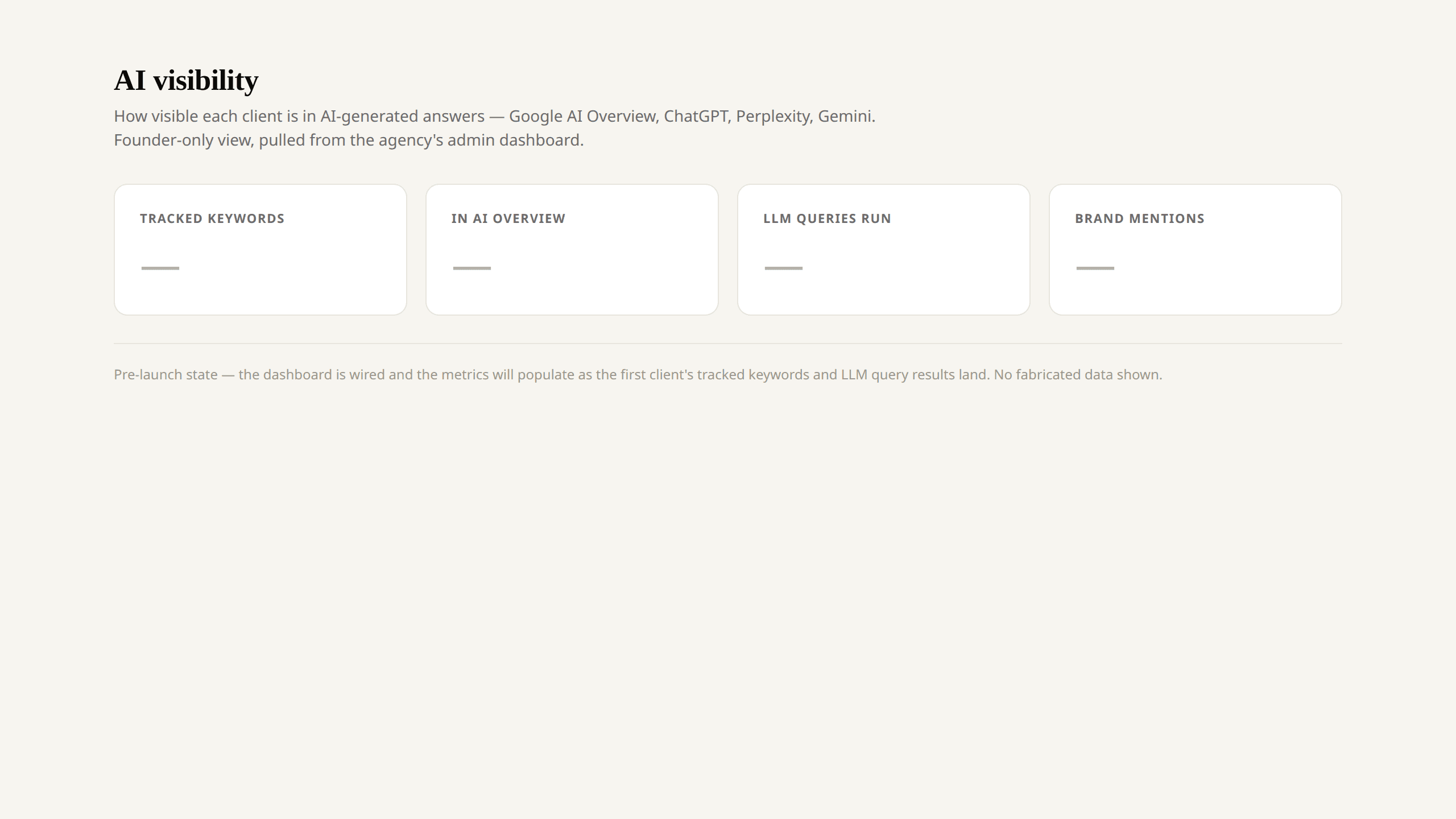
- Tracked keywords that surface an AI Overview — how many of your target terms now trigger an AI Overview at all. If this is zero, you have an indexing problem, not an authority problem.
- AI Overview citation rate — of those Overview-triggering keywords, what percentage cite your domain. Most trades clients I onboard sit at 5–10%; the working target is 30%+.
- LLM query mention rate — across the 20–40 prompts that match your services, what percentage mention your business by name. This is the number that moves fastest when you fix citations and third-party mentions.
- Position within the LLM answer — not just cited, but ranked 1st, 2nd, 3rd in the recommendation list. I score first-mention, second-mention and so on separately because the click-through gap between them is huge.
- Review velocity — new reviews per month on Google, Checkatrade, TrustATrader, Yell. AI models weight momentum, not just lifetime totals.
- Schema coverage — what percentage of service pages carry valid FAQPage, Service, and Organization JSON-LD. Below 80% and you are leaving the easiest wins on the table.
llms.txtpresence and freshness — file exists, lists services and locations accurately, last updated within 90 days. A stale llms.txt is a worse signal than no file at all.- Third-party citation count — distinct domains that mention your business by name across the open web. This is the single biggest lever and the slowest to move, which is why most agencies ignore it.
The tactical first step, before any of the above: open it right now and ask ChatGPT (or Perplexity, which makes its citations public) the question your best customer would ask — “best plumber in Bristol”, “emergency electrician Manchester”, whatever fits. If your business is not in the answer, you have a baseline to beat. If it is, you have a baseline to defend. Either way, that single prompt tells you more than an hour of reading this post.
Third-party citation count — distinct domains that mention your business by name across the open web — is the single biggest lever and the slowest to move, which is why most agencies ignore it.
Time to result
Two distinct timelines. For Google AI Overviews, measurable progress in 4–8 weeks once schema and content structure are live. For ChatGPT / Perplexity / Gemini brand mentions, 2–4 months — the crawlers re-index on different cadences, and LLM training-corpus inclusion happens on a much longer cycle. We measure progress monthly and surface it in the dashboard.
Should a local business care?
Honestly: right now, mostly yes. The earlier v1 of this post said “mostly not” — that was September 2026, a few weeks before this update. The data has moved. A meaningful share of trades-related searches now happen in ChatGPT / Perplexity / Gemini / Google AI Overviews, and that share grows every quarter. The businesses that get cited early get compounding benefits as the AI models reinforce their recommendations.
If you're running a local service business and you want to be ahead of the curve (and you want the “yes we do that” answer when a prospect asks “do you do AEO?”), then yes, it matters. The audit includes the AEO crawlability check by default — run it once, see where you stand.